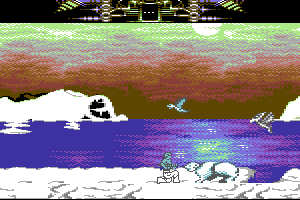
About the game
Another World begins with a lightning strike on a particle accelerator and strands physicist Lester Knight Chaykin — Ferrari, cigarette and all — on a hostile alien planet. From its opening swim away from tentacled shadows, the game unfolds as pure cinema: no HUD, no score, no tutorial, just a man running, and an alien companion whose wordless friendship becomes the emotional spine of the story.
Éric Chahi built the game almost single-handedly, animating its flat-shaded polygon figures with rotoscoped fluidity that made every stumble and leap feel weighty. Death comes constantly and theatrically — dissolved, crushed, shot — but checkpoints are brisk, and each demise teaches the choreography of the next attempt. The laser pistol's charge-shield mechanic supplies the few firefights with surprising tactical depth.
Its influence runs through every game that trusts imagery over exposition — from Flashback the following year to the wordless indies of the 2010s. The archive documents it in its DOS incarnation, one stop in a journey across virtually every machine of the era.
Why it matters
Another World proved games could carry a story with zero dialogue and total aesthetic confidence. Its wordless storytelling and polygonal cinematography are foundational to the entire "cinematic" tradition.
Technical notes
A bespoke polygon engine — geometric figures, rotoscoped motion, full-screen cinematic cuts — small enough for Chahi to iterate alone, portable enough to reach a dozen platforms. Documented here in its DOS release.
Files & downloads
VG90 is a reference and discovery archive. We do not host game files; download buttons lead to the external source listed for the entry.
Download// Keep exploring
Similar Games
 1991
1991
Bit Warden
Bitmaster 8
An 8-bit platformer about locking doors instead of opening them: seal the castle's…
View details 1991
1991
Cartoon Jukebox
CD-i
From the 16-bit golden age, Cartoon Jukebox (1991) is documented in VG90's reference…
View details 1991
1991
Commander Keen: Keen Dreams
DOS
From the 16-bit golden age, Commander Keen: Keen Dreams (1991) is documented in VG90's…
View details 1991
1991
F1 GP Circuits
Amiga C64
Released in 1991, F1 GP Circuits is indexed by VG90 as part of the 16-bit golden age for…
View details