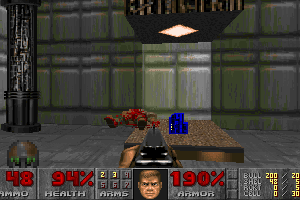
About the game
Doom dropped in December 1993 as a shareware episode and rewired what PC action games were allowed to feel like. You play a lone marine on the moons of Mars, carving through demons with a loadout that escalates from pistol to chainsaw to the BFG, across levels built from twisting corridors, hidden doors and light-flickering traps. The speed was the shock: where earlier 3D games trudged, Doom sprinted.
Under the surface sat clever engineering rather than brute force. The engine drew angled walls, variable floor heights, stairs and dim sectors fast enough to run on ordinary 386 and 486 machines, and it wrapped all of its content in WAD files that players could replace. That one packaging decision effectively invented the modding scene: level editors appeared within months, and thousands of community maps followed.
Doom also normalised multiplayer bloodsport. Its network mode let up to four players hunt each other across the same maps, and the word it coined for that — deathmatch — outlived the decade. The shareware model did the rest: the first episode spread freely across BBSs and cover disks, turning the full game into one of the defining PC purchases of the 90s.
Why it matters
Almost every first-person shooter since 1993 stands on this skeleton: fast movement, escalating arsenal, secrets, deathmatch and a mod community. "Doom clone" was the genre's actual name for years before "FPS" replaced it.
Technical notes
The renderer used binary space partitioning to draw sector-based 2.5D geometry at speed — variable heights and lighting, but no rooms above rooms. Content lived in WAD archives, a deliberately open format that made the game a platform as much as a product.
Files & downloads
VG90 is a reference and discovery archive. We do not host game files; download buttons lead to the external source listed for the entry.
Download// Keep exploring
Similar Games
 1993
1993
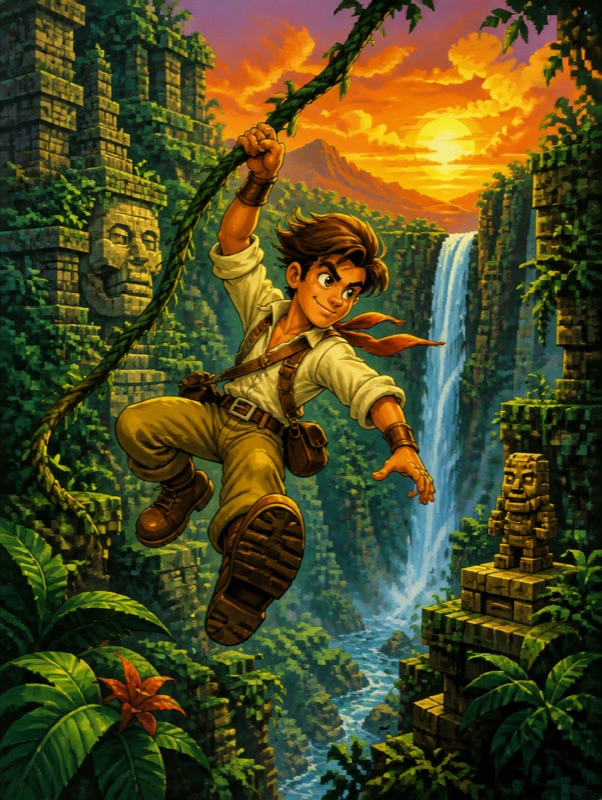
Jungle Byte Adventure
Nova 16
The 16-bit platformer with the era's best vine physics: momentum swings, secret ruins and…
View details 1993
1993
Vector Storm
ArcadeWorks
Pure-vector arena survival: one ship, luminous geometry, and a risk-loop where your…
View details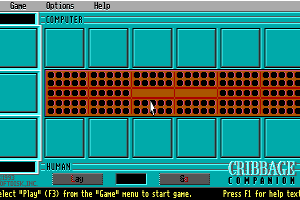 1993
1993
Big Blue Disk #80
DOS
Released in 1993, Big Blue Disk #80 is indexed by VG90 as part of the 16-bit golden age…
View details 1993
1993
Dragon's Lair
Mac DOS Arcade
Dragon's Lair (1993) is a title from the 16-bit golden age, catalogued in the VG90…
View details