// Archive entry № 25256
Quake
id Software's 1996 leap into true 3D: gothic arenas, a brooding industrial soundtrack, and the online deathmatch culture that never really ended.
- Players
- Region
- Worldwide
Rate this game
About the game
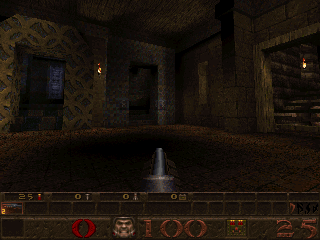
Quake was the violent transition from the 2.5D era to real 3D. Every wall, monster and projectile lived in genuine polygonal space, which meant rooms over rooms, vertiginous drops, and the birth of physics tricks like rocket jumping. The setting swapped Doom's techbase demons for something stranger — rusted military installations dissolving into gothic keeps, soaked in a brown-and-bronze palette and an oppressive industrial score.
The single-player campaign is a tight, hostile crawl, but Quake's deeper legacy is online. Built-in TCP/IP play, followed by the latency-tolerant QuakeWorld client, effectively founded internet deathmatch as a pastime — clans, dedicated servers, and eventually the first true esports scenes grew directly out of it.
Just as importantly, Quake doubled down on id's openness. The QuakeC scripting language let the community rewrite the game's rules, producing capture-the-flag and mods whose descendants became standalone genres. Between its engine licensing and its mod scene, a remarkable share of the following decade's shooters traces its lineage straight back here.
Why it matters
Quake made true-3D action, online deathmatch and moddable game logic mainstream in one release. Its engine family and community tools seeded shooters, mods and esports for a decade afterwards.
Technical notes
Fully polygonal BSP world with light-mapped shadows; software-rendered at launch, transformed by hardware-accelerated GLQuake soon after. QuakeC bytecode ran game logic, making total conversions practical. Ports in the archive range from Mac to SEGA Saturn.
Files & downloads
VG90 is a reference and discovery archive. We do not host game files; download buttons lead to the external source listed for the entry.
Download// Keep exploring
Similar Games
 1996
1996
Grim Harbor
Home Computer (DOS)
A rain-soaked point-and-click noir: one dock district, five suspects, and a fog system…
View details 1996
1996
Pixel Striker 96
Nova 16
Five-a-side arcade football with rocket shots, rain matches and a one-button tackle that…
View details 1996
1996
Aqua Rush
PocketByte
A handheld current-surfing platformer: ride, dive and chain streams as an axolotl courier…
View details 1996
1996
Black Touch 96
Arcade
From the leap into 3D, Black Touch 96 (1996) is documented in VG90's reference index for…
View details