About the game
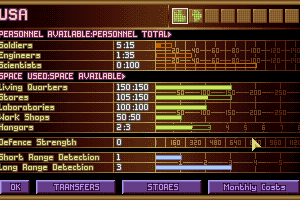
X-COM: UFO Defense (UFO: Enemy Unknown in Europe) welds two games together and makes each better. On the Geoscape, you run a clandestine agency defending 1990s Earth: placing bases, launching interceptors at UFO contacts, researching recovered alien tech and begging funding councils not to defect. On the Battlescape, every crash site becomes a turn-based nightmare — soldiers with time units, snap shots and shaking morale advancing through farmland and cornfields toward things they can't see.
The tension between layers is the engine of the drama. Autopsy research unlocks laser rifles your rookies will die carrying; a terror mission failed on the strategic map means a city panics and a funder walks. Soldiers are fragile, named and permanent — the sergeant who survives five missions becomes irreplaceable, then a Chryssalid finds her anyway, and the memorial wall grows.
Julian Gollop's design (published by MicroProse) is regularly voted among the greatest games ever made, and its DNA — permadeath squads, research trees, interlocked strategy and tactics — powers a whole modern genre of successors and remakes.
Why it matters
X-COM perfected the strategic/tactical hybrid and made permadeath emotional rather than punitive. Thirty years of squad-tactics games, including its own modern reboots, are built on this chassis.
Technical notes
Isometric destructible battlescapes with line-of-sight, day/night lighting and time-unit action economy, over a real-time strategic globe. The archive documents DOS and Amiga releases.
Files & downloads
VG90 is a reference and discovery archive. We do not host game files; download buttons lead to the external source listed for the entry.
Download// Keep exploring
Similar Games
 1994
1994
Neon Kart 1994
Nova 16 ArcadeWorks
Kart racing through rain-slick neon streets: sprite-scaled speed, battery-powered weapons…
View details 1994
1994
Hyper Vortex
Vectra 32 ArcadeWorks
A vertical shooter dive into a living vortex: geometry as the enemy, graze-to-charge…
View details 1994
1994
Manor of Whispers
Home Computer (DOS)
A haunted-house adventure where audio is the map: navigate by whispers, floorboards and…
View details 1994
1994
Pocket Puzzler DX
PocketByte
The handheld puzzle compendium done right: five interlocking games, one shared currency…
View details